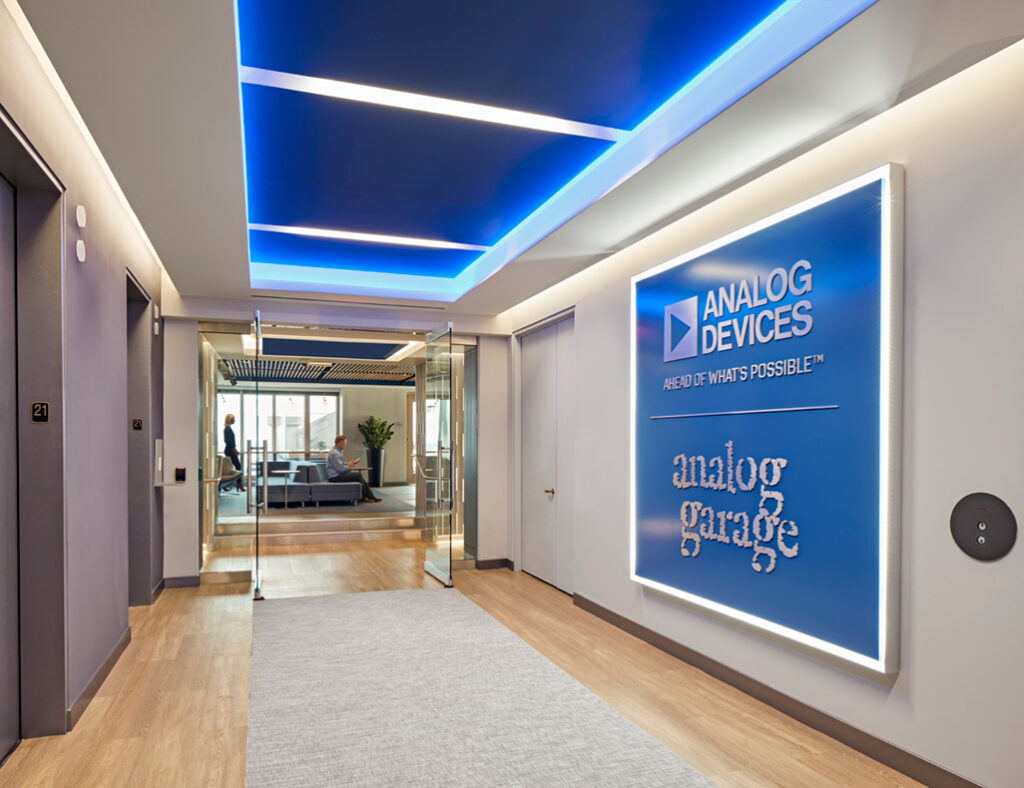
After my startup Lyric Semiconductor was acquired by Analog Devices, Inc. (ADI), it became a growing machine learning chipset division. During my time there, I also established a corporate research labs, started a venture capital group, and led the first investment (a MEMs-based mass spectrometer on a chip).
I modeled the “Analog Garage” after a venture incubator, much like the WyCombinator model. There were external startups we invested in and collaborated with, and internal startups generated from employee pitches, all in one big stew. To make it less cut-throat and more collaborative, if one of the internal projects got cut, its members could join another lab project that was still moving forward (or head back to their division). So the whole thing was always rotating and evolving.
We had a few of strict rules:
- We were always required to have an executive sponsor from a product division pay for a portion of every new project we started, and they would sit on the “board” of the internal “startup” that was created. This was designed so that when it came time to fully productize the new innovation, we would already have a sponsor to help us pass through the “valley of death” – technology transition – and get to a revenue generating product. y first mentor Stephen Rosenberg at Hewlett Packard Labs where I worked right after college always said, “Ben, start selling when you start building.“
- Whenever a project was ready to transition from labs to product division, the people had to transition to the division with it, even as their cost continued to be paid by the lab until the new product was making enough money to offset their cost. So no “lab lifers” – our entire goal was to put our people and innovations into the real world. And the principle is this: the people are the technology.
- We brought in a lot of interns from MIT and elsewhere. Anyone in the lab who wanted interns could have as many as they wanted. Cheap at twice the price! Interns were critical. Experienced engineers have too much experience, so they know all the things that can go wrong. They are like Wile E. Coyote in the Road Runner cartoons. They get out into open research space for a little bit, but then they inevitably glance down, and they fall.
By contrast interns are like the Road Runner. They just run right off the cliff and keep going, defying gravity! They have a lot less to lose and everything to gain. All they want is a publication out of the Summer, which they can get by doing some super interesting experiments that we can all learn from!
Plus, over lunch, the interns ended up telling us about all the cool stuff happening at their universities. And some of them came to work for us after they graduated as well. - Multiple teams informally talked about their projects at every weekly lab lunch. Not a formal review, but it provided a forum for frequent minor brainstorms, course corrections, and sounding boards. Every wall and window was a whiteboard. People talked out loud about their challenges. The culture was that teams helped each other.
- We had monthly “checkin” board meetings for each project in its first two years, with the sponsor from the division attending every one. Teams would know if they were going to hit cross winds far in advance, and have many chances to course correct.
In exchange for the control over the innovation pipeline provided to the product divisions, and the rotation of funded researchers into the divisions when it came time to productize a project, the labs got a lot more funding.
A lot of funding is fun, because it means there is generally enough extra slush so that you can do some fun little prototypes without asking permission — and it was often those little one-off projects that really opened people’s eyes to new possibilities. I felt that the most important part of my job was actually to make sure we were being crazy and “visionary” enough. For example I see from their website that ADI now seems to have a lot of work happening on biological chips. That didn’t exist when I started the labs, but it was a major thrust that I worked to cultivate while I was there.
I left to start another DARPA program and startup company, before I could really see if the innovation model worked, but the results of a quick web search say that there are on the order of 100 people working in the Analog Garage now (2026). That sounds like a healthy R&D lab!